
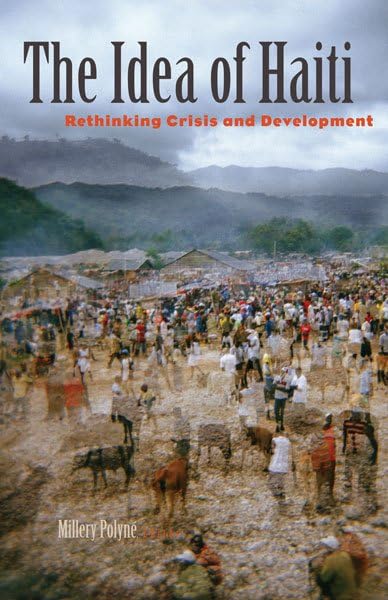
The idea of Haiti : rethinking crisis and development / Millery Polyné, editor.
Material type: TextLanguage: English Publisher: Minneapolis : University of Minnesota Press, 2013Description: xxxvii, 292 pages : illustrations ; 23 cmContent type:
 - text
- unmediated
- volume
- 9780816681327
- 0816681325
- Economic development -- Haiti
- Desarrollo económico -- Haití
- Economic assistance -- Haiti
- Asistencia económica -- Haití
- Humanitarian assistance -- Haiti
- Asistencia humanitaria -- Haití
- Haiti Earthquake, Haiti, 2010
- Terremotos -- Haití -- 2010
- Haiti -- Politics and government -- 21st century
- Haiti -- Economic conditions -- 21st century
- Haiti -- Social conditions -- 21st century
- Haiti -- Política y gobierno -- Siglo XXI
- Haití -- Condiciones económicas -- Siglo XXI
- Haití -- Condiciones sociales -- Siglo XXI
- 972.9407/3
- 110 F 1928.2 I19 2013
| Item type | Current library | Home library | Collection | Shelving location | Call number | Copy number | Status | Barcode | |
|---|---|---|---|---|---|---|---|---|---|
 Libro
Libro
|
Biblioteca Juan Bosch | Biblioteca Juan Bosch | Recursos Regionales | Recursos Regionales (2do. Piso) | 110 F 1928.2 I19 2013 (Browse shelf(Opens below)) | 1 | Available | 00000183504 |
Includes bibliographical references and index.
ContentsIntroduction. To Make Visible the “Invisible Epistemological Order”: Haiti, Singularity, and NewnessMillery PolynéI. Revolisyon/Kriz (Revolution/Crisis)1. Haiti, the Monstrous AnomalyNick Nesbitt2. Rethinking the Haitian CrisisGreg Beckett3. Remembering Charlemagne Péralte and His Defense of Haiti’s RevolutionYveline AlexisII. Moun/Demoun (Person/Dehumanized)4. Haiti: Fantasies of Bare LifeSibylle Fischer5. The Violence of Executive SilencePatrick Sylvain6. Religion at the Epicenter: Agency and Affiliation in Léogâne after the EarthquakeKaren RichmanIII. Èd (Aid)7. The Alliance for Progress: A Case Study of Failure of International Commitments to HaitiWien Weibert Arthus8. Urban Planning and the Rebuilding of Port-au-PrinceHarley F. Etienne9. Cholera and the Camps: Reaping the Republic of NGOsMark Schuller10. From Slave Revolt to a Blood Pact with Satan: The Evangelical Rewriting of Haitian HistoryElizabeth McAlister11. Twenty-First Century Haiti—A New Normal? A Conversation with Four Scholars of HaitiAlex Dupuy, Robert Fatton, Jr., Évelyne Trouillot, and Tatiana WahContributorsIndex
After Haiti was struck by a devastating earthquake on January 12, 2010, aid workers and offers of support poured in from around the world. Tellingly, though, news reports on the catastrophe and relief efforts frequently included a pejorative description of the country that outsiders were determined to rebuild: the troubled island nation, a nation plagued by political violence. There was much talk of inventing a "new" Haiti, which would presumably mimic Western modes of development and thus mitigate political instability and crisis
There are no comments on this title.