
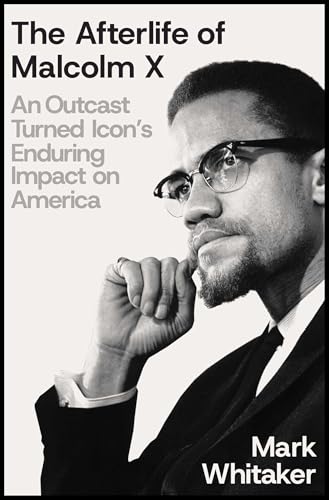
The afterlife of Malcolm X : an outcast turned icon's enduring impact on America / Mark Whitaker.
Material type: TextOriginal language: English Publisher: New York : Simon & Schuster, 2025Edition: First Simon & Schuster hardcover editionDescription: xxi, 426 pages : illustrations ; 24 cmContent type:
 - text
- unmediated
- volume
- 9781668033296 (hardback)
- 1668033291 (hardback)
- Outcast turned icon's enduring impact on America
- X, Malcolm, 1925-1965 -- Influence
- X, Malcolm, 1925-1965 -- Assassination
- X, Malcolm, 1925-1965
- African Americans -- Intellectual life
- Afroamericanos -- Vida intelectual
- Black Muslims -- Biography
- Musulmanes negros
- African American political activists -- Biography
- Activistas políticos
- Black power -- United States -- History
- Estados Unidos -- Civilización -- Influencias africanas
- 320.54/6092
- 002 E 185.97 W578a 2025
| Item type | Current library | Home library | Collection | Shelving location | Call number | Copy number | Status | Barcode | |
|---|---|---|---|---|---|---|---|---|---|
 Libro
Libro
|
Biblioteca Juan Bosch | Biblioteca Juan Bosch | Recursos Regionales | Recursos Regionales (2do. Piso) | 002 E 185.97 W578a 2025 (Browse shelf(Opens below)) | 1 | Available | 00000191652 |
Includes bibliographical references (pages 357-404) and index.
Prologue
Part one. Conviction: 1965-1967. Death in the afternoon ; The reporters ; The trial
Part two. Inspiration: 1966-1972. The autobiography ; Black Power! ; The athletes ; The Black Arts movement
Part three. Obsession: 1969-1979. A letter from prison ; Three "pawn sacrifices" ; Part four. Rediscovery: 1983-2020. The rappers ; The movie ; Hero to the right and left ; From Obama to Black Lives Matter
Part five. Exoneration: 2017-2021. The reinvestigations ; An apology
Epilogue
"Malcolm X has become as much of an American icon as Abraham Lincoln, John F. Kennedy, or Martin Luther King Jr. But when he was murdered in 1965, he was still seen as a dangerous outsider. White America found him frightening, mainstream African Americans found him divisive, and even his admirers found him bravely radical. Although he was famously eulogized by Ossie Davis as a 'black shining prince,' Malcolm X never received the mainstream acceptance toward which he seemed to be striving in his final year. It is more in death than in life that Malcolm's influence has blossomed and come to leave a deep imprint on the cultural landscape of America. With impeccable research and original reporting, Mark Whitaker tells the story of Malcolm X's far-reaching posthumous legacy. It stretches from founders of the Black Power movement to hip hop pioneers such as Public Enemy and Tupac Shakur. Leaders of the Black Arts and Free Jazz movements, from Maya Angelou to John Coltrane, credited their political awakening to Malcolm, as did some of the most influential athletes of our time. He has been cited as a formative influence by both Barack Obama, who found a model in Malcolm's 'unadorned insistence on respect'- and Clarence Thomas, who was drawn to Malcolm's messages of self-improvement and economic self-help. In compelling new detail, Whitaker also retraces the long road to exoneration for two men wrongfully convicted of Malcolm's murder, making The Afterlife of Malcolm X essential reading for anyone interested in American politics, history, culture, and true crime."--Jacket cover
There are no comments on this title.