
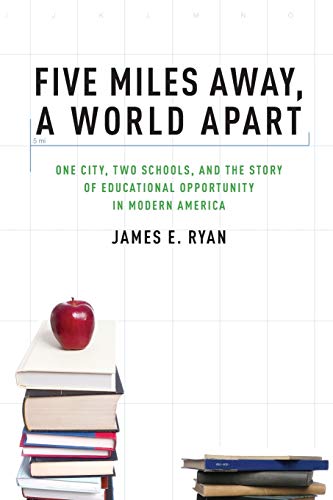
Five miles away, a world apart : one city, two schools, and the story of educational opportunity in modern America / James E. Ryan.
Material type: TextLanguage: English Publication details: Oxford ; New York : Oxford University Press, 2011.Description: ix, 384 pages ; 24 cmContent type:
 - text
- unmediated
- volume
- 9780199836857 (paperback : alk. paper)
- 019983685X (paperback : alk. paper)
- 5 miles away, a world apart
- Segregation in education -- Law and legislation -- United States
- Education -- United States -- Regional disparities
- Discrimination in education -- Law and legislation -- United States
- School integration -- Law and legislation -- United States
- Segregación en la enseñanza -- Legislación -- Historia -- Estados Unidos
- Discriminación en la educación -- Legislación -- Estados Unidos
- Integración escolar -- Legislación -- Estados Unidos
- 344.73/0798
- KF 4155 R988f 2011
| Item type | Current library | Home library | Collection | Shelving location | Call number | Copy number | Status | Barcode | |
|---|---|---|---|---|---|---|---|---|---|
 Libro
Libro
|
Biblioteca Juan Bosch | Biblioteca Juan Bosch | Ciencias Sociales | Ciencias Sociales (3er. Piso) | KF 4155 R988f 2011 (Browse shelf(Opens below)) | 1 | Available | 00000196758 |
Includes bibliographical references (pages 347-369) and index.
Introduction: Freeman and Tee Jay
pt. I. Past: school desegregation and middle America : Buying time ; Don't cross that line
pt. II. Present: save the cities, spare the suburbs : Desegregating dollars ; Like a Russian novel: school finance litigation in state courts ; Limited choices ; The impact of choice and the role of courts ; Lowering the bar: the standards and testing movement
pt. III. Future: demography is opportunity : In search of ties that bind
Epilogue : Freeman and Tee-Jay revisited
How is it that, half a century after Brown v. Board of Education, educational opportunities remain so unequal for black and white students, not to mention poor and wealthy ones? In this book the author answers this question by tracing the fortunes of two schools in Richmond, Virginia--one in the city and the other in the suburbs. Ryan shows how court rulings in the 1970s, limiting the scope of desegregation, laid the groundwork for the sharp disparities between urban and suburban public schools that persist to this day. The Supreme Court, in accord with the wishes of the Nixon administration, allowed the suburbs to lock nonresidents out of their school systems. City schools, whose student bodies were becoming increasingly poor and black, simply received more funding, a measure that has proven largely ineffective, while the independence (and superiority) of suburban schools remained sacrosanct. Weaving together court opinions, social science research, and compelling interviews with students, teachers, and principals, Ryan explains why all the major education reforms since the 1970s--including school finance litigation, school choice, and the No Child Left Behind Act--have failed to bridge the gap between urban and suburban schools and have unintentionally entrenched segregation by race and class. As long as that segregation continues, Ryan forcefully argues, so too will educational inequality. --From back cover of book
There are no comments on this title.