
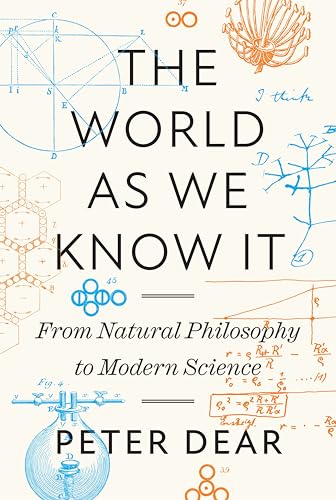
The world as we know it : from natural philosophy to modern science / Peter Dear
Material type: TextLanguage: English Publication details: Princeton, New Jersey : Princeton University Press, 2025Description: viii, 370 pages : illustrations ; 24 cmISBN:
 - 9780691235844
- 0691235848
- Q 125 D285w 2025
| Item type | Current library | Home library | Collection | Shelving location | Call number | Copy number | Status | Barcode | |
|---|---|---|---|---|---|---|---|---|---|
 Libro
Libro
|
Biblioteca Juan Bosch | Biblioteca Juan Bosch | Humanidades | Humanidades (4to. Piso) | Q 125 D285w 2025 (Browse shelf(Opens below)) | 1 | Available | 00000197012 |
Introduction: Natural philosophy and the sciences
Divine order: Isaac Newton and physico-theology
Celestial order and universal gravity
Mixed mathematics and probability
Inventories of electricity
Organization: Living things
Cleaning up chemistry: The classification of matter
Laplace, revolutionary order, and the invention of mathematical physics
Entr'acte: Institutions and pedagogy
Classification and extinction: Cuvier and natural history in the early nineteenth century
Darwin's taxonomy: Geology and the organization of life
Evolution and scientific naturalism
Thermodynamics and modern physics
Chance and determinism: New models of science
Electromagnetism, action at a distance, and aether
The chemical use of atoms
Laboratories of the heavens: Physics in the observatory
New modes of natural philosophy
Conclusion: The world we have gained...and lost
Science is the basis of our assumptions about ourselves and our world, from ideas about our evolutionary past to our conceptions of the vast expanses of space and the smallest particles of matter. In this panoramic book, acclaimed historian of science Peter Dear uncovers the roots of such beliefs, revealing how they constitute a natural philosophy that has been developed and refined over the course of centuries--and how the world as we have come to know it was by no means inevitable. In a sweeping, multifaceted narrative, Dear describes some of the most breathtaking accomplishments in the advance of human knowledge, such as Isaac Newton's laws of motion and gravitation, Carl Linnaeus's taxonomy, Antoine Lavoisier's new chemistry, Charles Darwin's theory of evolution, and Albert Einstein's theories of relativity. Challenging the notion that science is only about "making discoveries," he shows how our world has been formed by people, institutions, and cultural assumptions, giving rise to disciplines ranging from biology and astrophysics to electromagnetism and the social sciences. Taking readers from the early eighteenth century to today, The World as We Know It reveals how our ideas about our place in the universe were bequeathed to us by individuals, cultures, and a curiosity that knows no bounds
There are no comments on this title.