
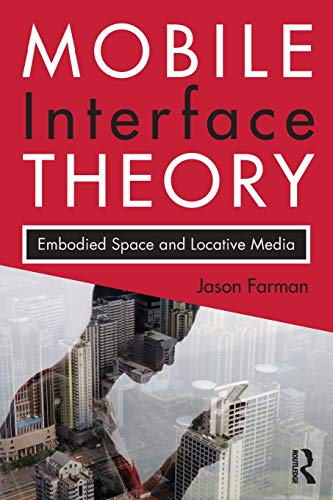
Mobile interface theory : embodied space and locative media / Jason Farman.
Material type: TextLanguage: English Publication details: New York : Routledge, 2012.Description: xii, 168 pages : illustrations ; 23 cmContent type:
 - text
- unmediated
- volume
- 9780415878913 (pbk)
- 0415878918 (pbk)
- 9780203847664
- 004
- QA 76.59 F233m 2012
| Item type | Current library | Home library | Collection | Shelving location | Call number | Copy number | Status | Barcode | |
|---|---|---|---|---|---|---|---|---|---|
 Libro
Libro
|
Biblioteca Juan Bosch | Biblioteca Juan Bosch | Colección de Tecnología | Humanidades (4to. Piso) | QA 76.59 F233m 2012 (Browse shelf(Opens below)) | 1 | Available | 00000198849 |
Includes bibliographical references and index.
Introduction: The Pathways of Locative Media 1. Embodiment and the Mobile Interface 2. Mapping and Representations of Space 3. Locative Interfaces and Social Media 4. The Ethics of Immersion in Locative Games 5. Performances of Asynchronous Time 6. Site-Specific Storytelling and Reading Interfaces 7. Conclusion: Movement/Progress/Obsolescence: On the Politics of Mobility
"Mobile media -- from mobile phones to smartphones to netbooks -- are transforming our daily lives. We communicate, we locate, we network, we play, and much more through our mobile devices. In Mobile Interface Theory, Jason Farman demonstrates how the worldwide adoption of mobile technologies is causing a reexamination of the core ideas about what it means to live our everyday lives. He argues that mobile media's pervasive computing model, which allows users to connect and interact with the internet while moving across a wide variety of locations, produces a new sense of self -- a new embodied identity that stems from virtual space and material space regularly enhancing, cooperating or disrupting each other. Exploring a range of mobile media practices, including mobile maps and GPS technologies, location-aware social networks, urban and alternate reality games that use mobile devices, performance art, and storytelling projects, Farman illustrates how mobile technologies are changing the ways we produce lived, embodied spaces"-- Provided by publisher.
There are no comments on this title.