
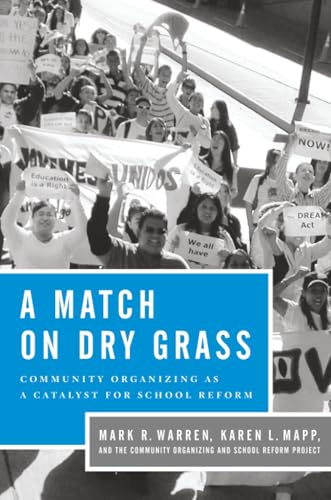
A match on dry grass : community organizing as a catalyst for school reform / Mark R. Warren, Karen L. Mapp, and The Community Organizing and School Reform Project.
Material type: TextLanguage: English Publication details: New York : Oxford University Press, c2011.Description: xii, 316 pages, 8 unnumbered pages of plates : illustrations ; 24 cmContent type:
 - text
- unmediated
- volume
- 9780199793587 (pbk. : alk. paper)
- 0199793581 (pbk. : alk. paper)
- School improvement programs -- United States
- Mejoramiento de programas escolares -- Estados Unidos
- Educational change -- United States -- Citizen participation
- Cambio educativo -- Participación ciudadana -- Estados Unidos
- Educational accountability -- United States
- Educación -- Rendición de cuentas -- Estados Unidos
- Community organization -- United States
- Organización de la comunidad -- Estados Unidos
- Community power -- United States
- Poder comunitario -- Estados Unidos
- Social action -- United States
- Acción social -- Estados Unidos
- 371.2/07
- LB 2822.82 W291m 2011
| Item type | Current library | Home library | Collection | Shelving location | Call number | Copy number | Status | Barcode | |
|---|---|---|---|---|---|---|---|---|---|
 Libro
Libro
|
Biblioteca Juan Bosch | Biblioteca Juan Bosch | Humanidades | Humanidades (4to. Piso) | LB 2822.82 W291m 2011 (Browse shelf(Opens below)) | 1 | Available | 00000199881 |
Includes bibliographical references and index.
Introduction: A new movement for equity and justice in education
How community organizing works
"A match on dry grass": organizing for great schools in San Jose
"An appetite for change": building relational cultures for educational reform and civic engagement in Los Angeles
"Our strength is the power of our community": political education and the continuation of the struggle in Denver
"Weaving a tapestry that won't unravel": the transformation of education in the Mississippi Delta
"Acts of leadership": building powerful forms of parent participation in Chicago
"Cement between the bricks": building schools and communities in New York City
Building power and relationships to transform communities and schools
Conclusion: Lessons for school reform and democracy building
Appendix: A collaborative research process
Argues that community organizing represents a fresh and promising approach to school reform as part of a broader agenda to build power for low-income communities and address the profound social inequalities that affect the education of children. Based on a comprehensive national study, presents rich and compelling case studies of prominent organizing efforts in Chicago, New York City, Los Angeles, Denver, San Jose, and the Mississippi Delta. The authors show how organizing groups build the participation and leadership of parents and students so they can become powerful actors in school improvement efforts. They also identify promising ways to overcome divisions and create the collaborations between educators and community residents required for deep and sustainable school reform. Shows how community organizing builds powerful relationships that lead to the transformational change necessary to advance educational equity and a robust democracy. From publisher description
There are no comments on this title.