
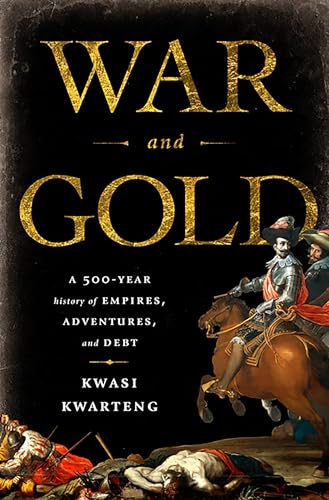
War and gold : a 500-year history of empires, adventures, and debt / Kwasi Kwarteng.
Material type: TextPublisher: New York : PublicAffairs, 2014Edition: First editionDescription: 424 pages, 8 unnumbered pages of plates : illustrations ; 24 cmContent type:
- text
- unmediated
- volume
- 9781586487683 (hardcover)
- 158648768X (hardcover)
- 332.4222
- HG 289 K98w 2014
| Item type | Current library | Home library | Collection | Shelving location | Call number | Vol info | Copy number | Status | Barcode | |
|---|---|---|---|---|---|---|---|---|---|---|
 Libro |
Biblioteca Juan Bosch | Biblioteca Juan Bosch | Ciencias Sociales | Ciencias Sociales (3er. Piso) | HG 289 K98w 2014 (Browse shelf(Opens below)) | 1 | 1 | Available | 00000112973 |
Includes bibliographical references (pages 363-410) and index.
Gold : the establishment of order, c. 1500-1914. Sweat of the sun ; Rival nations : England and France ; Revolutions ; Pillars of order ; Great republic ; London 1914 -- War : the consequences of Armageddon, 1914-1915. guns and shells ; victors and vanquished ; World crisis ; Bretton Woods -- The new dollar order, 1945-1973. Pax Americana ; Weary titans ; Japan Incorporated ; Imperial retreat -- Paper : the end of gold, 1973- . The impact of oil ; Thatcher and Reagan ; The creation of the Euro -- The rise of China ; Delusions of debt ; Crises and 'bailouts' -- Appendix. Value of gold stock to world GDP.
This history of money describes the gold standard, which began in 16th century Spain's quest to collect as much gold as possible through the introduction of paper money as a means of wartime financing during the French and American Revolutions.
"The world was wild for gold. After discovering the Americas, and under pressure to defend their vast dominion, the Habsburgs of Spain promoted gold and silver exploration in the New World with ruthless urgency. But, the great influx of wealth brought home by plundering conquistadors couldn' t compensate for the Spanish government' s extraordinary military spending, which would eventually bankrupt the country multiple times over and lead to the demise of the great empire. Gold became synonymous with financial dependability, and following the devastating chaos of World War I, the gold standard came to express the order of the free market system. Warfare in pursuit of wealth required borrowing - a quickly compulsive dependency for many governments. And when people lost confidence in the promissory notes and paper currencies issued during wartime, governments again turned to gold. In this captivating historical study, Kwarteng exposes a pattern of war-waging and financial debt - bedmates like April and taxes that go back hundreds of years, from the French Revolution to the emergence of modern-day China. His evidence is as rich and colorful as it is sweeping. And it starts and ends with gold."--book jacket.
There are no comments on this title.