
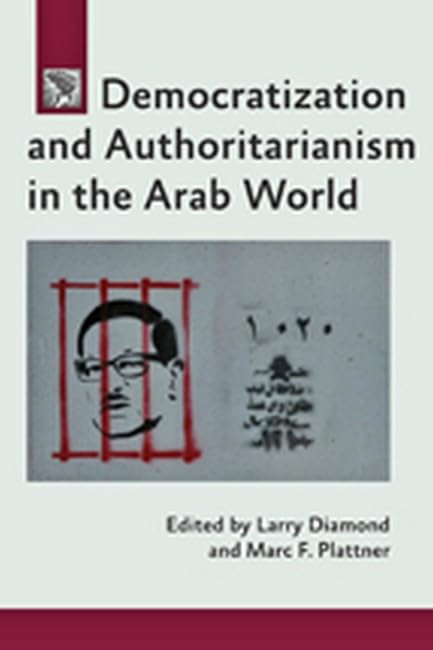
Democratization and authoritarianism in the Arab world / edited by Larry Diamond and Marc F. Plattner.
Material type: TextLanguage: English Series: Journal of democracy bookPublisher: Baltimore : Johns Hopkins University Press, 2014Description: xxxiii, 388 pages ; 24 cmContent type:
- text
- unmediated
- volume
- 9781421414164 (pbk. : alk. paper)
- 1421414163 (pbk. : alk. paper)
- 9781421414171 (electronic)
- 1421414171 (electronic)
- Democratization -- Arab countries -- History -- 21st century
- Authoritarianism -- Arab countries -- History -- 21st century
- Arab Spring, 2010-
- Islam and politics -- History -- 21st century
- Primavera Árabe, 2010-
- Autoritarismo -- Historia -- Países árabes -- Siglo XXI
- Democratización -- Países árabes
- Islam y política -- Historia -- Siglo XXI
- 320.917/4927
- JQ 1850 D383 2014
| Item type | Current library | Home library | Collection | Shelving location | Call number | Copy number | Status | Barcode | |
|---|---|---|---|---|---|---|---|---|---|
 Libro |
Biblioteca Juan Bosch | Biblioteca Juan Bosch | Ciencias Sociales | Ciencias Sociales (3er. Piso) | JQ 1850 D383 2014 (Browse shelf(Opens below)) | 1 | Available | 00000165715 |
Includes bibliographical references and index.
AcknowledgmentsIntroductionPart I: Thematic EssaysChapter 1. The Languages of the Arab RevolutionsChapter 2. The Transformation of the Arab WorldChapter 3. Arab Democracy or Islamist Revolution?Chapter 4. There Will Be No Islamist RevolutionChapter 5. Islamists and Democracy: Cautions from PakistanChapter 6. New Findings on Arabs and DemocracyChapter 7. The Split in Arab CultureChapter 8. Democratization Theory and the "Arab Spring"Chapter 9. Transforming the Arab World's Protection-Racket PoliticsChapter 10. Resilient Royals: How Arab Monarchies Hang OnChapter 11. Why the Modest Harvest?Chapter 12. The Global ContextChapter 13. The Lessons of 1989Chapter 14. The Role of the MilitaryChapter 15. The Impact of Election SystemsChapter 16. The Role of Digital MediaPart II: Country Studies Chapter 17. Ben Ali's FallChapter 18. Tunisia's Transition and the "Twin Tolerations"Chapter 19. The Road to (and from) Liberation SquareChapter 20. Egypt: Why Liberalism Still MattersChapter 21. Egypt's Failed TransitionChapter 22. Yemen Changes Everything . . . and NothingChapter 23. Libya Starts from ScratchChapter 24. Syria and the Future of AuthoritarianismChapter 25. Bahrain's Decade of DiscontentChapter 26. Algeria versus the Arab SpringChapter 27. Morocco: Outfoxing the OppositionChapter 28. Jordan: The Ruse of ReformChapter 29. Is Saudi Arabia Immune?Index
Beginning in December 2010, a series of uprisings swept the Arab world, toppling four longtime leaders and creating an apparent political opening in a region long impervious to the "third wave" of democratization. Despite the initial euphoria, the legacies of authoritarianism--polarized societies, politicized militaries, state-centric economies, and pervasive clientelism--have proven stubborn obstacles to the fashioning of new political and social contracts. Meanwhile, the strong electoral performance of political Islamists and the ensuing backlash in Egypt have rekindled arguments about the compatibility of democracy and political Islam. Even though progress toward democracy has been halting at best, the region's political environment today bears little resemblance to what it was before the uprisings. In "Democratization and Authoritarianism in the Arab World," leading scholars address the questions posed by this period of historic change in the Middle East and North Africa. This volume includes chapters examining several broad themes: the region's shifting political culture, the relationship between democracy and political Islam, the legacy of authoritarian ruling arrangements, the strengths and vulnerabilities of remaining autocracies, and the lessons learned from transitions to democracy in other parts of the world. It also features chapters analyzing the political development of individual countries: Algeria, Bahrain, Egypt, Jordan, Libya, Morocco, Saudi Arabia, Syria, Tunisia, Yemen, and the monarchies of the Gulf. In Democratization and Authoritarianism in the Arab World, leading scholars address the questions posed by this period of historic change in the Middle East and North Africa. This volume includes chapters examining several broad themes: the region's shifting political culture, the relationship between democracy and political Islam, the legacy of authoritarian ruling arrangements, the strengths and vulnerabilities of remaining autocracies, and the lessons learned from transitions to democracy in other parts of the world. It also features chapters analyzing the political development of individual countries: Algeria, Bahrain, Egypt, Jordan, Libya, Morocco, Saudi Arabia, Syria, Tunisia, Yemen, and the monarchies of the Gulf
There are no comments on this title.