
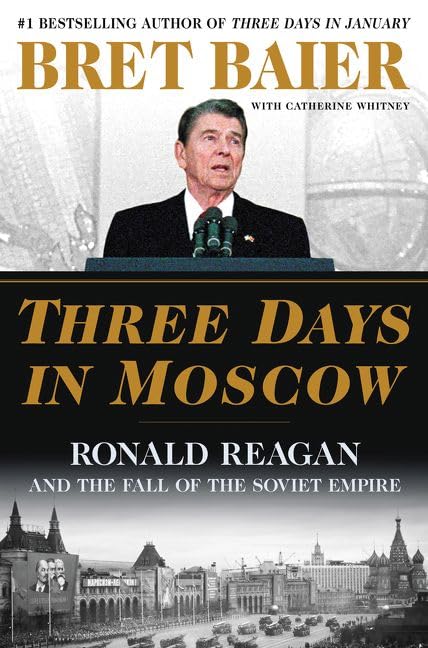
Three days in Moscow : Ronald Reagan and the fall of the Soviet empire / Bret Baier with Catherine Whitney.
Material type: TextLanguage: English Publisher: New York, NY : William Morrow, an imprint of HarperCollins Publishers, 2018Edition: First editionDescription: xvi, 397 pages, 16 unnumbered pages of plates : illustrations (chiefly color) ; 24 cmContent type:
- text
- still image
- unmediated
- volume
- 9780062748362 (hardcover)
- 006274836X (hardcover)
- 9780062871466 (Barnes & Noble FD signed edition)
- 0062871463 (Barnes & Noble FD signed edition)
- 9780062871473 (Barnes & Noble signed edition)
- 0062871471 (Barnes & Noble signed edition)
- 9780062871459 (Books-A-Million signed edition)
- 0062871455 (Books-A-Million signed edition)
- 9780062871442 (BJ's signed edition)
- 0062871447 (BJ's signed edition)
- 3 days in Moscow
- Ronald Reagan and the fall of the Soviet empire
- Reagan, Ronald -- Travel -- Russia (Federation) -- Moscow
- Gorbachev, Mikhail Sergeevich, 1931-
- Reagan, Ronald, 1911-2004 -- Viajes -- Rusia (Federación)
- Gorbachev, Mijail, 1931-
- Summit meetings -- Soviet Union
- Cold War
- Guerra fría
- United States -- Foreign relations -- Soviet Union
- Soviet Union -- Foreign relations -- United States
- United States -- Foreign relations -- 1981-1989
- United States -- Foreign relations -- Soviet Union
- United States -- Foreign relations -- 1981-1989
- Estados Unidos -- Relaciones exteriores -- Unión Soviética
- Unión soviética -- Relaciones exteriores -- Estados Unidos
- Estados Unidos -- Relaciones exteriores -- 1981-1989
- 327.73047
- 002 E 183.8 B152t 2018
| Item type | Current library | Home library | Collection | Shelving location | Call number | Copy number | Status | Barcode | |
|---|---|---|---|---|---|---|---|---|---|
 Libro |
Biblioteca Juan Bosch | Biblioteca Juan Bosch | Recursos Regionales | Recursos Regionales (2do. Piso) | 002 E 183.8 B152t 2018 (Browse shelf(Opens below)) | 1 | Available | 00000203708 |
Includes bibliographical references and index.
Introduction: Finding Reagan -- Prologue: The walk -- Reagan's destiny -- Speaking truth -- Three days in Moscow-- Dreams for the future -- Appendix: Ronald Reagan's speech at Moscow State University.
"On May 31, 1988, Reagan addressed a packed audience at Moscow State University, with a remarkable -- yet now largely forgotten -- speech that capped his first visit to the Soviet capital. This fourth in a series of summits between Reagan and Soviet General Secretary Mikhail Gorbachev was a dramatic coda to their tireless efforts to reduce the nuclear threat. More than that, Reagan viewed it as 'a grand historical moment': an opportunity to light a path for the Soviet people -- toward freedom, human rights, and a future he told them they could embrace if they so chose. It was the first time an American president had given an address about freedom and human rights on Russian soil. Reagan had once called the Soviet Union an 'evil empire, ' but now, saying that depiction was from 'another time, ' he beckoned the Soviets to join him in a new vision of the future. The importance of Reagan's Moscow speech was largely overlooked at the time, but the new world he spoke of was fast approaching. The following year, in November 1989, the Berlin Wall fell and the Soviet Union began to disintegrate, leaving the United States the sole superpower on the world stage. Today, the end of the Cold War is perhaps the defining historical moment of the past half century, and must be understood if we are to make sense of America's current place in the world amid the re-emergence of US-Russian tensions during Vladimir Putin's tenure. Using Reagan's three days in Moscow to tell the larger story of the president's critical and often misunderstood role in orchestrating a peaceful ending to the Cold War, Baier illuminates the character of one of our nation's most venerated leaders, and reveals the unique qualities that allowed Reagan to succeed in forming an alliance for peace with the Soviet Union when his predecessors had fallen short" -- Front and back jacket flaps.
There are no comments on this title.