
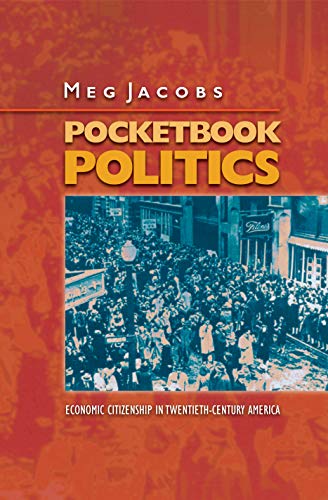
Pocketbook politics : economic citizenship in twentieth-century America / Meg Jacobs.
Material type: TextSeries: Politics and society in twentieth-century AmericaPublication details: Princeton, N.J. : Princeton University Press, c2005.Description: xii, 349 p. : ill. ; 25 cmISBN:
 - 0691086648 (alk. paper)
- 9780691086644 (alk. paper)
- Income distribution -- United States -- History -- 20th century
- Purchasing power -- United States -- History -- 20th century
- United States -- Politics and government -- 20th century
- Consumption (Economics) -- United States -- History -- 20th century
- United States -- Economic conditions -- 20th century
- 339.4/2/09730904
- HC 110 J17p 2005
| Item type | Current library | Home library | Collection | Shelving location | Call number | Vol info | Copy number | Status | Barcode | |
|---|---|---|---|---|---|---|---|---|---|---|
 Libro
Libro
|
Biblioteca Juan Bosch | Biblioteca Juan Bosch | Ciencias Sociales | Ciencias Sociales (3er. Piso) | HC 110 J17p 2005 (Browse shelf(Opens below)) | 1 | 1 | Available | 00000073051 |
Includes bibliographical references and index.
From the bargain basement to the bargaining table, 1900-1917 -- Business without a buyer, 1917-1930 -- The New Deal and the problem of prices, 1930-1935 -- The New Deal and the problem of wages, 1935-1940 -- The consumer goes to war, 1940-1946 -- Pocketbook politics in an age of inflation, 1946-1960.
'How much does it cost?' We think of this question as one that preoccupies the nation's shoppers, not its statesmen. But, as "Pocketbook Politics" dramatically shows, the twentieth-century American polity in fact developed in response to that very consumer concern. In this groundbreaking study, Meg Jacobs demonstrates how pocketbook politics provided the engine for American political conflict throughout the twentieth century. From Woodrow Wilson to Franklin Roosevelt to Richard Nixon, national politics turned on public anger over the high cost of living. Beginning with the explosion of prices at the turn of the century, every strike, demonstration, and boycott was, in effect, a protest against rising prices and inadequate income.On one side, a reform coalition of ordinary Americans, mass retailers, and national politicians fought for laws and policies that promoted militant unionism, government price controls, and a Keynesian program of full employment. On the other, small businessmen fiercely resisted this low-price, high-wage agenda that threatened to bankrupt them. This book recaptures this dramatic struggle, beginning with the immigrant Jewish, Irish, and Italian women who flocked to Edward Filene's famous Boston bargain basement that opened in 1909 and ending with the Great Inflation of the 1970's. "Pocketbook Politics" offers a new interpretation of state power by integrating popular politics and elite policymaking. Unlike most social historians who focus exclusively on consumers at the grass-roots, Jacobs breaks new methodological ground by insisting on the centrality of national politics and the state in the nearly century-long fight to fulfill the American Dream of abundance.
There are no comments on this title.