
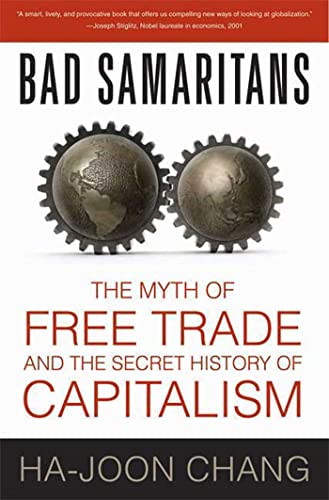
Bad samaritans : the myth of free trade and the secret history of capitalism / Ha-Joon Chang.
Material type: TextPublication details: New York : Bloomsbury Press, 2008.Edition: Pbk. edDescription: xi, 276 pages ; 21 cmISBN:
 - 9781596915985
- 1596915986
- 9781596913998
- 1596913991
- 382.71
- HF 1713 C456b 2008
| Item type | Current library | Home library | Collection | Shelving location | Call number | Copy number | Status | Barcode | |
|---|---|---|---|---|---|---|---|---|---|
 Libro
Libro
|
Biblioteca Juan Bosch | Biblioteca Juan Bosch | Ciencias Sociales | Ciencias Sociales (3er. Piso) | HF 1713 C456b 2008 (Browse shelf(Opens below)) | 1 | Available | 00000066792 |
Incluye referencias bibliográficas e índice.
Acknowledgements -- Prologue : Mozambique's economic miracle : How to escape poverty -- 1. The Lexus and the olive tree revisted : myths and facts about globalization -- 2. The double life of Daniel Defoe : How did the rich countries become rich? -- 3. My six-year-old son should get a job : Is free trade always the answer? -- 4. The Finn and the elephant : Should we regulate foreign investment? -- 5. Man exploits man : Private enterprise good, public enterprise bad? -- 6. Windows 98 in 1997 : Is it wrong to 'borrow' ideas? -- 7. Mission impossible? : Can financial prudence go too far? -- 8. Zaire vs Indonesia : Should we turn our backs on corrupt and undemocratic countries? -- 9. Lazy Japanese and thieving Germans : Are some cultures incapable of economic development? -- Epilogue : Säao Paulo, October 2037 : Can things get better? -- Notes -- Index.
Contrarian economist Chang blasts holes in the "World Is Flat" theories of Thomas Friedman and other neo-liberal economists who argue that only unfettered capitalism and wide-open international trade can lift struggling nations out of poverty. On the contrary, Chang shows, today's economic superpowers--from the United States to Britain to his native South Korea--all attained prosperity by protectionism and government intervention in industry. We in the wealthy nations have conveniently forgotten this fact, telling ourselves a fairy tale about the magic of free trade and forcing policies that suit ourselves on the developing world. Unlike typical economists who construct models of how economies are supposed to behave, Chang examines the past: what has actually happened. He calls on America to return to its abandoned role, embodied in programs like the Marshall Plan, to offer a helping hand, instead of a closed fist, to countries struggling to follow in our footsteps.--From publisher description.
There are no comments on this title.