
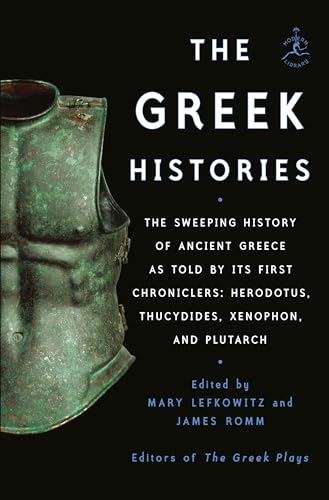
The Greek histories : the sweeping history of Ancient Greece as told by its first chroniclers: Herodotus, Thucydides, Xenophon, and Plutarch / Mary R. Lefkowitz; James S. Romm
Language: eng Publication details: New York : The Modern Library, 2022Description: 442 p.: ill.; 24 cmISBN:- 9781984854308
- G793 2022
| Item type | Current library | Home library | Collection | Shelving location | Call number | Copy number | Status | Barcode | |
|---|---|---|---|---|---|---|---|---|---|
 Libro
Libro
|
Biblioteca Juan Bosch | Biblioteca Juan Bosch | Automatización y Procesos Técnicos | Automatización y Procesos Técnicos (1er. Piso) | G793 2022 (Browse shelf(Opens below)) | 1 | Available | 00000164959 |
Introduction
Herodotus
Thucydides
Xenophon
Plutarch
Appendix
Glossary
"The historians of Ancient Greece were pioneers of a new literary craft, and their work stands among the most enduring and important legacies of the Western world and the foundation of a major discipline. This highly readable edition includes key selections from Herodotus--often called the "father of history"--Thucydides, Xenophon, and Plutarch, whose biographies drew on primary sources since lost to history. It collects their most popular, and most widely taught, work in a single, accessible volume. The stories included here chart the landmark events of Ancient Greece--the Persian War, Peloponnesian War, and the lives of Alexander the Great and Demetrius--and add up to a sweeping portrait of the Hellenic world. The Greek historians were also the first to explore the possibilities of their craft, introducing, at the very dawn of the field, the concept that historical writing is far more than a chronicle of past events. Taken together, the Greek histories draw attention to each author's emphasis on religion, leadership, character, and the lessons to be drawn from war. How, for instance, should readers interpret Herodotus's inclusion of speeches and dialogues, dreams, and oracles as part of the "factual" record? What did Thucydides understand about human nature that (as he said) stays constant throughout time? How did Plutarch frame historical biography as a form of portraiture, a means of depicting the moral qualities of the great? Thucydides and Xenophon were also contemporaries of the eras they wrote about--the original word "historie" meaning "inquiry"--so their work provides a vital eyewitness account of turbulent times"-- Provided by publisher
There are no comments on this title.