
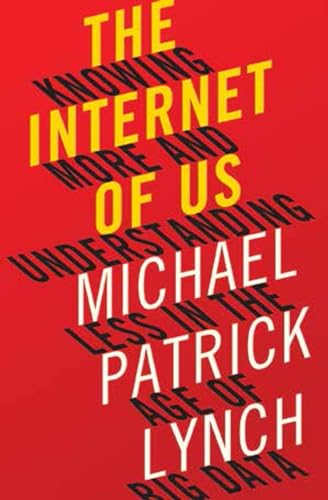
The Internet of us : knowing more and understanding less in the age of big data / Michael Patrick Lynch.
Material type: TextLanguage: English Publisher: New York : Liveright Publishing Corporation, a division of W.W. Norton & Company, [2016]Edition: First EditionDescription: xviii, 237 pages ; 25 cmContent type:
 - text
- unmediated
- volume
- 9780871406613 (hardcover)
- 0871406616 (hardcover)
- 001
- BD 161 L987i 2016
| Item type | Current library | Home library | Collection | Shelving location | Call number | Copy number | Status | Barcode | |
|---|---|---|---|---|---|---|---|---|---|
 Libro
Libro
|
Biblioteca Juan Bosch | Biblioteca Juan Bosch | Humanidades | Humanidades (4to. Piso) | BD 161 L987i 2016 (Browse shelf(Opens below)) | 1 | Available | 00000164710 |
Includes bibliographical references (pages 205-214) and index.
pt. I The new old problems of knowledge
1. Our digital form of life
Neuromedia
Socrates on the way to Larissa
Welcome to the library
2. Google-knowing
Easy answers
Being receptive: downloading facts
John Locke agrees with mom
Being reasonable: uploading reasons
3. Fragmented reasons : is the Internet making us less reasonable?
The abstract society
When fights break out in the library
The rationalist's delusion
Democracy as a space of reasons
4. Truth, lies, and social media
Deleting the truth
The real as virtual
Interlude: to SIM or not to SIM
Falsehood, fakes and the noble lie
Objectivity and our constructed world
pt. II: How we know now
5. Who wants to know : privacy and autonomy
Life in the panopticon
The values of privacy
The pool of information
Privacy and the concept of a person
Transparency and power
6. Who does know : crowds, clouds, and networks
Dead metaphors
Knowledge ain't just in (your) head
The knowing crowd
The "netography" of knowledge
7. Who gets to know : the political economy of knowledge
Knowledge democratized?
Epistemic equality
Walmarting the university
8. Understanding and the digital human
Big knowledge
The end of theory?
Understanding understanding
Knowing how to chuck
Coming to understand as a creative act
9. The Internet of us
Technology and understanding
Information and the ties that bind
With far-reaching implications, this urgent treatise promises to revolutionize our understanding of what it means to be human in the digital age. We used to say "seeing is believing"; now googling is believing. With 24/7 access to nearly all of the world's information at our fingertips, we no longer trek to the library or the encyclopedia shelf in search of answers. We just open our browsers, type in a few keywords and wait for the information to come to us. Indeed, the Internet has revolutionized the way we learn and know, as well as how we interact with each other. And yet this explosion of technological innovation has also produced a curious paradox: even as we know more, we seem to understand less. While a wealth of literature has been devoted to life with the Internet, the deep philosophical implications of this seismic shift have not been properly explored until now. Demonstrating that knowledge based on reason plays an essential role in society and that there is much more to "knowing" than just acquiring information, leading philosopher Michael Patrick Lynch shows how our digital way of life makes us overvalue some ways of processing information over others, and thus risks distorting what it means to be human. With far-reaching implications, Lynch's argument charts a path from Plato's cave to Shannon's mathematical theory of information to Google Glass, illustrating that technology itself isn't the problem, nor is it the solution. Instead, it will be the way in which we adapt our minds to these new tools that will ultimately decide whether or not the "Internet of Things"--All those gadgets on our wrists, in our pockets and on our laps--will be a net gain for humanity. Along the way, Lynch uses a philosopher's lens to examine some of the most urgent issues facing digital life today, including how social media is revolutionizing the way we think about privacy; why a greater reliance on Wikipedia and Google doesn't necessarily make knowledge "more democratic"; and the perils of using "big data" alone to predict cultural trends. Promising to modernize our understanding of what it means to be human in the digital age, The Internet of Us builds on previous works by Nicholas Carr, James Gleick and Jaron Lanier to give us a necessary guide on how to navigate the philosophical quagmire that is the Information Age
There are no comments on this title.