
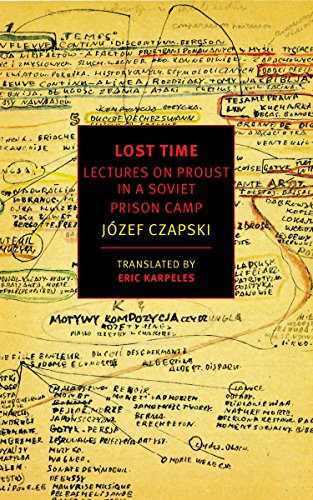
Lost time : lectures on Proust in a Soviet prison camp / by Józef Czapski ; translated from the French by Eric Karpeles.
Material type: TextLanguage: English Original language: Polish Series: New York Review Books classicsPublisher: New York : New York Review Books, 2018Description: xxxiv, 90 pages, 8 unnumbered pages of plates : illustrations (some color) ; 21 cmContent type:
 - text
- unmediated
- volume
- 9781681372587 (softcover)
- 1681372584 (softcover)
- Proust contre la déchéance. English
- 843/.912
- PQ 2631 C998l 2018
| Item type | Current library | Home library | Collection | Shelving location | Call number | Copy number | Status | Barcode | |
|---|---|---|---|---|---|---|---|---|---|
 Libro
Libro
|
Biblioteca Juan Bosch | Biblioteca Juan Bosch | Humanidades | Humanidades (4to. Piso) | PQ 2631 C998l 2018 (Browse shelf(Opens below)) | 1 | Available | 00000168247 |
"An NYRB original"--Page [4] of cover
"First published in the French language as Proust contre la decheance: conférences au camp du Griazowietz by Les Editions Noir sur Blanc"--Title page verso
"The first translation of painter and writer Jozef Czapski's inspiring lectures on Proust, first delivered in a prison camp in the Soviet Union during World War II. During the Second World War, in the heart of the malevolent Soviet Union, a Polish prisoner of war brought Marcel Proust's novel À la recherche du temps perdu to life without a single page of text available for reference. Presenting a series of lectures in an attempt to distract his fellow officers from their collective misery, Jozef Czapski managed to revive the novel and his experience of reading it purely from memory. It was a clarifying moment for him, a Proustian moment. His talks were given in French, helping to focus the men's minds and distract their thoughts from their grim surroundings. Calling upon deep reserves of aesthetic knowledge and critical thinking in a variety of languages, Czapski offered aspects of Proust's story, like Scheherazade, night after night. His lectures are a testament to the survival of memories of both worlds woven together, the fictional Faubourg Saint-Germain and the actual Soviet prison camp"-- Provided by publisher.
There are no comments on this title.