
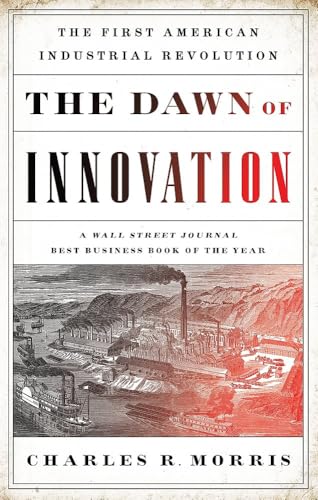
The dawn of innovation : the first American Industrial Revolution / Charles R. Morris ; illustrations by J. E. Morris.
Material type: TextLanguage: English Publication details: New York : PublicAffairs, 2012.Description: xiv, 368 pages : illustrations ; 25 cmISBN:
 - 9781610393577 (pbk.)
- 1610393570 (pbk.)
- 9781610390491 (electronic)
- 1610390490 (electronic)
- Industrialization -- United States -- History -- 19th century
- Industrialización -- Historia -- Estados Unidos -- Siglo XIX
- Industrial revolution -- United States
- Revolucion industrial -- Estados Unidos
- United States -- Economic conditions -- 19th century
- Estados Unidos -- Condiciones económicas -- Siglo XIX
- United States -- Social conditions -- 19th century
- Estados Unidos -- Condiciones sociales -- Siglo XIX
- 338.097309
- HC 105 M875d 2012
| Item type | Current library | Home library | Collection | Shelving location | Call number | Copy number | Status | Barcode | |
|---|---|---|---|---|---|---|---|---|---|
 Libro
Libro
|
Biblioteca Juan Bosch | Biblioteca Juan Bosch | Ciencias Sociales | Ciencias Sociales (3er. Piso) | HC 105 M875d 2012 (Browse shelf(Opens below)) | 1 | Available | 00000120467 |
Includes bibliographical references and index.
The shipbuilders' war -- The hyperpower -- The giant as adolescent -- American arms: Whitney, North, Blanchard, and Hall -- The rise of the West -- America is number two -- On the main stage -- The newest hyperpower -- Catching up to the hyperpower: a reprise? -- Appendix: Did Eli Whitney invent the cotton gin?
From the author comes the story of the rise of American industry between the War of 1812 and the Civil War. It describes industry in America between the War of 1812 and the Civil War and how this period of growth in the first half of the century built the platform for Carnegie, Rockefeller and Morgan in the second half. In the thirty years after the Civil War, the United States blew by Great Britain to become the greatest economic power in world history. That is a well-known period in history, when titans like Andrew Carnegie, John D. Rockefeller, and J.P. Morgan walked the Earth. But as the author shows, the platform for that spectacular growth spurt was built in the first half of the century. By the 1820s, America was already the world's most productive manufacturer, and the most intensely commercialized society in history. The War of 1812 jumpstarted the great New England cotton mills, the iron centers in Connecticut and Pennsylvania, and the forges around the Great Lakes. In the decade after the War, the Midwest was opened by entrepreneurs. In this book, the author paints a panorama of a new nation buzzing with the work of creation. He also points out the parallels and differences in the nineteenth century American/British standoff and that between China and America today
There are no comments on this title.