
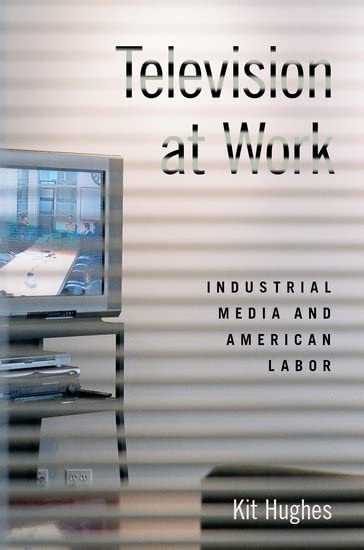
Television at work : industrial media and American labor / Kit Hughes.
Material type: TextLanguage: English Publisher: New York, NY : Oxford University Press, 2020Description: 304 pages : illustrations ; 25 cmContent type:
 - text
- unmediated
- volume
- 9780190855796 (paperback)
- 0190855797 (paperback)
- 9780190855789 (hardback)
- 0190855789 (hardback)
- Television in management -- United States -- History -- 20th century
- Industrial television -- United States -- History -- 20th century
- Industria de la televisión -- Estados Unidos -- Historia -- Siglo XX
- Labor -- United States -- History -- 20th century
- Trabajo -- Estados Unidos -- Historia -- Siglo XX
- Industrial management -- United States -- History -- 20th century
- Gestión industrial -- Estados Unidos -- Historia
- 651.7
- HD 30.34 H893t 2020
| Item type | Current library | Home library | Collection | Shelving location | Call number | Copy number | Status | Barcode | |
|---|---|---|---|---|---|---|---|---|---|
 Libro
Libro
|
Biblioteca Juan Bosch | Biblioteca Juan Bosch | Humanidades | Humanidades (4to. Piso) | HD 30.34 H893t 2020 (Browse shelf(Opens below)) | 1 | Available | 00000170170 |
Includes bibliographical references and index.
Introduction Chapter 1: The Persistence of [a] Vision: the Electronically Mediated CorporationPrehistoryChapter 2: "To extend vision beyond the horizon, to see the unseen": Industrial Television in the Post-War EraFlowChapter 3: Frankly Boring and Agonizingly Slow: Television Moves to the OfficeImmediacyChapter 4: The Other Format Wars: Cartridges, Cassettes, and Making Home WorkTime-shiftingChapter 5: "The People's Network": Soft Management with Satellite Business Television NarrowcastingConclusionAcknowledgements
"This book explores how work, television, and waged labor come to have meaning in our everyday lives. However, it is not an analysis of workplace sitcoms or quality dramas. Instead, it explores the forgotten history of how American private sector workplaces used television in the twentieth century. In traces how, at the hands of employers, television physically and psychically managed workers and attempted to make work meaningful under the sign of capitalism. It also shows how the so-called domestic medium helped businesses shape labor relations and information architectures foundational to the twinned rise of the technologically mediated corporation and a globalizing information economy. Among other things, business and industry built extensive private television networks to distribute live and taped programming, leased satellite time for global 'meetings' and program distribution, created complex CCTV data search and retrieval systems, encouraged the use of videotape for worker self-evaluation, used video cassettes for training distributed workforces, and wired cantinas for employee entertainment. Television at work describes the myriad ways the medium served business' attempts to shape employees' relationships to their labor and the workplace in order to secure industrial efficiency, support corporate expansion, and inculcate preferred ideological orientations. narrowcasting, immediacy, time-shifting, flow, Post-Fordism, labor, audience labor, video, satellite, CCTV"-- Provided by publisher.
There are no comments on this title.