
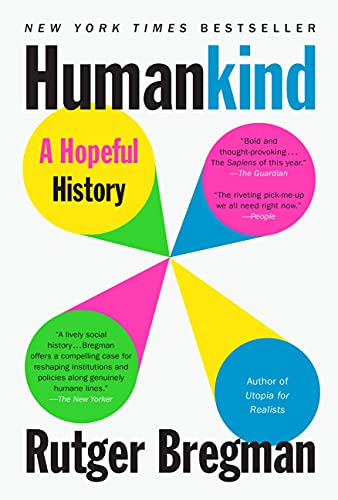
Humankind : A hopeful history / Rutger Bregman ; translated from the Dutch by Elizabeth Manton and Erica Moore.
Material type: TextLanguage: English Original language: Dutch Publisher: New York, NY : Back Bay Books / Little, Brown and Company, 2021Edition: First English-language editionDescription: xviii, 461 pages : illustrations, map, portraits ; 21 cmContent type:
 - text
- still image
- cartographic image
- unmediated
- volume
- 9780316418522 (pbk.)
- 0316418528 (pbk.)
- Meeste mensen deugen. English
- 128
- HM 1146 B833h 2021
| Item type | Current library | Home library | Collection | Shelving location | Call number | Copy number | Status | Barcode | |
|---|---|---|---|---|---|---|---|---|---|
 Libro
Libro
|
Biblioteca Juan Bosch | Biblioteca Juan Bosch | Ciencias Sociales | Ciencias Sociales (3er. Piso) | HM 1146 B833h 2021 (Browse shelf(Opens below)) | 1 | Available | 00000178539 |
Originally published 2019 in the Netherlands as De meeste mensen deugen by De Correspondent. Original English-language hardcover edition published by Little, Brown and Company, 2020
Includes bibliographical references (pages 401-452) and index.
Prologue -- 1. A new realism -- 2. The real Lord of the Flies -- Part 1. The State of Nature -- 3. The rise of Homo puppy -- 4. Colonel Marshall and the soldiers who wouldn't shoot -- 5. The curse of civilisation -- 6. The mystery of Easter Island -- Part 2. After Auschwitz -- 7. In the basement of Stanford University -- 8. Stanley Milgram and the shock machine -- 9. The death of Catherine Susan Genovese -- Part 3. Why Good People Turn Bad -- 10. How empathy blinds -- 11. How power corrupts -- 12. What the Enlightenment got wrong -- Part 4. A New Realism -- 13. The power of intrinsic motivation -- 14. Homo ludens -- 15. This is what democracy looks like -- Part 5. The Other Cheek -- 16. Drinking tea with terrorists -- 17. The best remedy for hate, injustice and prejudice -- 18. When the soldiers came out of the trenches -- Epilogue. Ten Rules to Live By -- Acknowledgments -- Notes -- Index.
It's a belief that unites the left and right, psychologists and philosophers, writers and historians. It drives the headlines that surround us and the laws that touch our lives. From Machiavelli to Hobbes, Freud to Dawkins, the roots of this belief have sunk deep into Western thought. Human beings, we're taught, are by nature selfish and governed by self-interest. Humankind makes a new argument : that it is realistic, as well as revolutionary, to assume that people are good. The instinct to cooperate rather than compete, trust rather than distrust, has an evolutionary basis going right back to the beginning of Homo sapiens. By thinking the worst of others, we bring out the worst in our politics and economics too. In this major book, internationally bestselling author Rutger Bregman takes some of the world's most famous studies and events and reframes them, providing a new perspective on the last 200,000 years of human history. From the real-life Lord of the Flies to the Blitz, a Siberian fox farm to an infamous New York murder, Stanley Milgram's Yale shock machine to the Stanford prison experiment, Bregman shows how believing in human kindness and altruism can be a new way to think - and act as the foundation for achieving true change in our society. It is time for a new view of human nature.
Translated into English from the original Dutch
There are no comments on this title.