
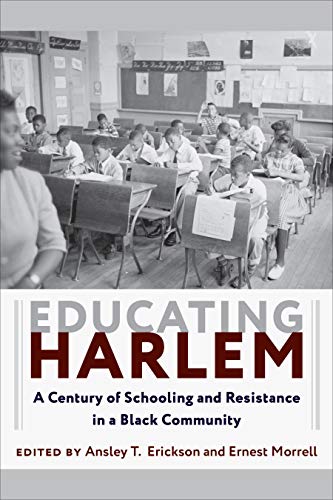
Educating Harlem : a century of schooling and resistance in a Black community / edited by Ansley T. Erickson and Ernest Morrell.
Material type: TextLanguage: English Publisher: New York : Columbia University Press, 2019Description: xi, 360 pages : illustrations, maps ; 23 cmContent type:
 - text
- unmediated
- volume
- 9780231182218 (paperback)
- 023118221X (paperback)
- African Americans -- Education -- New York (State) -- New York -- History -- 20th century
- Afroamericanos -- Educación -- Nueva York (Estado) -- Siglo XX
- Discrimination in education -- New York (State) -- New York -- History -- 20th century
- Discriminación en la educación -- Nueva York (Estado) -- Historia -- Siglo XX
- Racism in education -- New York (State) -- New York -- History -- 20th century
- Racismo en la educación -- Nueva York (Estado) -- Historia -- Siglo XX
- African Americans -- Social conditions -- 20th century
- Afroamericanos -- Condiciones sociales -- Siglo XX
- School improvement programs -- New York (State) -- New York
- Mejoramiento de programas escolares -- Nueva York (Estado)
- 371.829/960747/1
- LC 2803 E24 2019
| Item type | Current library | Home library | Collection | Shelving location | Call number | Copy number | Status | Barcode | |
|---|---|---|---|---|---|---|---|---|---|
 Libro
Libro
|
Biblioteca Juan Bosch | Biblioteca Juan Bosch | Humanidades | Humanidades (4to. Piso) | LC 2803 E24 2019 (Browse shelf(Opens below)) | 1 | Available | 00000193138 |
Includes bibliographical references and index.
AcknowledgmentsAbbreviationsIntroduction, by Ansley T. Erickson and Ernest MorrellPart I. Debating What and How Harlem Students Learn in the Renaissance and Beyond1. Schooling the New Negro: Progressive Education, Black Modernity, and the Long Harlem Renaissance, by Daniel Perlstein2.“A Serious Pedagogical Situation”: Diverging School Reform Priorities in Depression Era Harlem, by Thomas Harbison3. Wadleigh High School: The Price of Segregation, by Kimberley JohnsonPart II. Organizing, Writing, and Teaching for Reform in the 1930s Through 1950s4. Cinema for Social Change: The Human Relations Film Series of the Harlem Committee of the Teachers Union, 1936–1950, by Lisa Rabin and Craig Kridel5. Bringing Harlem to the Schools: Langston Hughes’s The First Book of Negroes and Crafting a Juvenile Readership, by Jonna Perrillo6. Harlem Schools and the New York City Teachers Union, by Clarence TaylorPart III. Divergent Educational Visions in the Activist 1960s and 1970s7. HARYOU: An Apprenticeship for Young Leaders, by Ansley T. Erickson8. Intermediate School 201: Race, Space, and Modern Architecture in Harlem, by Marta Gutman9. Black Power as Educational Renaissance: The Harlem Landscape, by Russell Rickford10. “Harlem Sophistication”: Community-based Paraprofessional Educators in Central Harlem and East Harlem, by Nick JuravichPart IV. Post–Civil Rights Setbacks and Structural Alternatives to Public Schooling11. Harlem Schools in the Fiscal Crisis, by Kim Phillips-Fein and Esther Cyna12. Pursuing “Real Power to Parents”: Babette Edwards’s Activism from Community Control to Charter Schools, by Brittney Lewer13. Teaching Harlem: Black Teachers and the Changing Educational Landscape of Twenty-First Century Central Harlem, by Bethany L. Rogers and Terrenda C. WhiteConclusion, by Ernest Morrell and Ansley T. EricksonContributorsIndex
"Since the beginning of the twentieth century, education has been a mechanism of opportunity and oppression for the African American community in Harlem. In Educating Harlem, a multi-disciplinary group of scholars document and analyze how Harlemites defined and pursued their educational ambitions in the face of political and economic challenges ranging from poverty and racism to government indifference. The contributors consider the individuals, organizations, and initiatives that fostered an educational vision for Harlem, from Harlem Renaissance figures who sought to reform the curriculum to efforts in the 1970s to develop and defend auxiliary aspects of schooling in the face of severe budget cuts. Examining a wide range of actors, the volume provides new ways of thinking about social movements and activism that includes both the efforts of large-scale organizations as well as smaller-scale efforts led by parents or para-professionals. Challenging the conventional "rise-and-fall" narratives found in many urban histories, the volume instead focuses on the on-going (if not always successful) efforts of Harlem residents to imagine and implement improvements for their schools"-- Provided by publisher.
There are no comments on this title.