
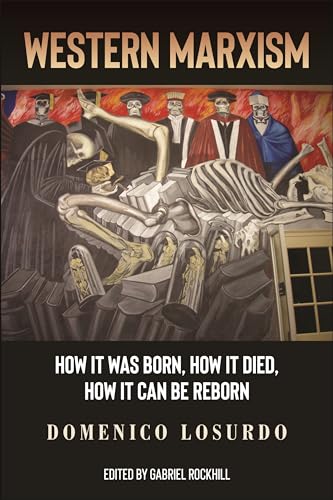
Western Marxism : how it was born, how it died, how it can be reborn / by Domenico Losurdo ; edited by Gabriel Rockhill ; with an introduction by Jennifer Ponce De León and Gabriel Rockhill ; translated by Steven Colatrella with George De Stefano.
Material type: TextLanguage: English Original language: Italian Publisher: New York : Monthly Review Press, 2024Description: 309 pages ; 21 cmContent type:
 - text
- unmediated
- volume
- 9781685900625 (paperback)
- 1685900623 (paperback)
- Marxism occidentale. English
- 335.43
- HX 40 L881w 2024
| Item type | Current library | Home library | Collection | Shelving location | Call number | Copy number | Status | Barcode | |
|---|---|---|---|---|---|---|---|---|---|
 Libro
Libro
|
Biblioteca Juan Bosch | Biblioteca Juan Bosch | Ciencias Sociales | Ciencias Sociales (3er. Piso) | HX 40 L881w 2024 (Browse shelf(Opens below)) | 1 | Available | 00000190508 |
Originally published as Il marxismo occidentale: Come nacque, come morì, come può rinascere by Domenico Losurdo by Gius, Laterza & Figli S.p.A, Bari, Italy (2017). English translation by Steven Colatrella with George De Stefano published by Monthly Review Press 2024 by Monthly Review Press.
Includes bibliographical references and index.
"Western Marxism: How It Was Born, How It Died, How It Can Be Reborn is a paradigm-shifting book that provides a trenchant critique of the Western left intelligentsia. It reveals how its dominant ideological orientation-characterized by defeatism, utopianism, and anti-communism-is rooted in the political economy of imperialism. Internationally acclaimed theorist Domenico Losurdo thus provides a fresh and challenging perspective on purportedly radical thinkers who have been widely promoted in the imperial core, including those affiliated with the Frankfurt School, French Theory, and operaismo, as well as Hannah Arendt, Giorgio Agamben, Michael Hardt, and Slavoj Žižek, among others. His critique also has wide-reaching implications for trend-setting discourses inspired by this coterie of intellectuals, from postcolonial and decolonial theory to subaltern studies and beyond. Far from being a negative undertaking, however, this book is grounded in the positive project of reigniting anti-imperialist Marxism"-- Provided by publisher.
There are no comments on this title.