
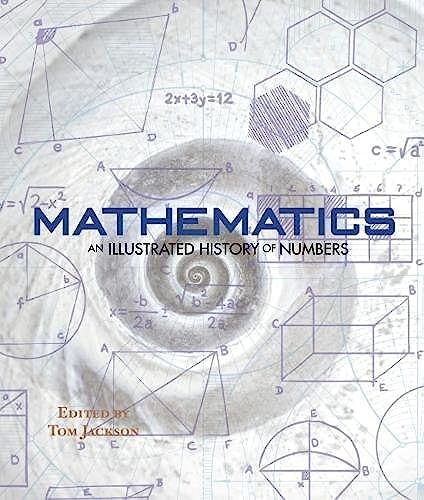
Mathematics : an illustrated history of numbers / edited by Tom Jackson ; contributors, Richard Beatty, James Bow, Mike Goldsmith, Dan Green, Tom Jackson, Robert Sneddon, Susan Watt.
Material type: TextLanguage: English Publication details: New York : Shelter Harbor Press, 2020Description: 144 pages : illustrations (some color) ; 24 cmISBN:
 - 9781627950824
- 1627950826
- QA 21 M426 2020
| Item type | Current library | Home library | Collection | Shelving location | Call number | Copy number | Status | Barcode | |
|---|---|---|---|---|---|---|---|---|---|
 Libro
Libro
|
Biblioteca Juan Bosch | Biblioteca Juan Bosch | Humanidades | Humanidades (4to. Piso) | QA 21 M426 2020 (Browse shelf(Opens below)) | 1 | Available | 00000194939 |
Includes bibliographical references and index.
Introduction. Prehistory to the middle ages. Learning to count -- Positional notation -- The abacus -- Pythagoras theorem -- The Rhind papyrus -- Zero -- The math of music -- The golden ratio -- Platonic solids -- Logic -- Geometry -- Magic squares -- Prime numbers -- Pi -- Measuring the earth -- The powers of ten -- The modern calendar -- Diophantine equations -- Hindu-Arabic number system -- Algorithms -- Cryptography -- Algebra -- Fibonacci sequence. The renaissance and the age of enlightenment. Perspective geometry -- Nonlinear equations -- Pendulum law -- X and y -- Ellipses -- Logarithms -- Napier's bones -- Slide rule -- Complex numbers -- Cartesian coordinates -- Laws of fall -- Calculators --Pascal's triangle -- Chance -- Principle of induction -- Calculus -- Math of gravity -- Binary numbers. New numbers, new theories. Exponential growth constant -- Graph theory -- Three-body problem -- Euler's identity -- Bayes' theorem -- Maskelyne and the personal equation -- Malthusianism -- Fundamental theorem of algebra -- Perturbation theory -- Central limit theorem -- Fourier analysis -- The mechanical computer -- Bessel function -- Group theory -- Non-Euclidean geometry -- The average person -- The poisson distribution -- Quaternions -- Transcendental numbers -- Finding Neptune -- Fechner-Weber law -- Boolean algebra -- Maxwell-Boltzmann -- Defining irrationals -- Infinity -- Set theory -- Peano axioms -- Simple lie groups -- Statistical techniques. Modern mathematics. Topology -- A new geometry -- Hilbert's 23 problems -- Mass energy -- Markov chains -- Population genetics -- Foundations of mathematics -- General relativity -- The mathematics of quantum physics -- Godel's theorem -- Turing machine -- Fields medals -- Zuse and the electronic computer -- Game theory -- Information theory -- Geodesics -- Chaos theory -- String theory -- Catastrophe theory -- Four-color theorem -- Public key encryption -- Fractals -- The fourth dimension and beyond -- Classification of all simple finite groups -- Self-organized critically -- Fermat's last theorem -- Proof by computer -- Millennium problems -- Poincare conjecture -- The search for Mersenne primes. 101 mathematics: a guide -- Imponderables -- The great mathematicians.
Here is the essential guide to mathematics, an authoritative reference book and timeline that explores the work of history s greatest mathematicians. These include the teasing genius of Pierre de Fermat, who said he knew the answers but rarely gave them up, the helpful guidance of Fibonacci, whose 13th-century compendium for bookkeepers proved to be a valuable tool for the most high-minded mathematicians, and the fractal pattern discovered by Wac aw Sierpinski now used to plan the route a mailman takes. With a glimpse of the abstract landscapes of infinite numbers and multi-dimensional shapes that these incredible minds explore, we can begin to get beyond school-day sums and understand the true power of mathematics.
There are no comments on this title.