
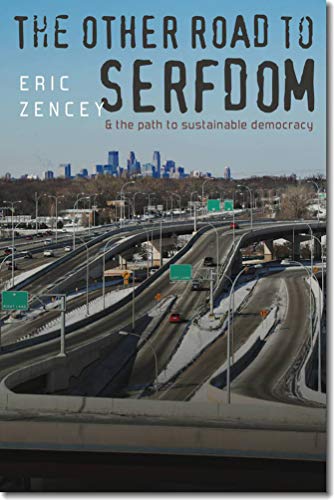
The other road to serfdom & the path to sustainable democracy / by Eric Zencey.
Material type: TextLanguage: English Publication details: Hanover, [NH] : University Press of New England, c2012.Description: xxix, 299 pages ; 24 cmContent type:
 - text
- unmediated
- volume
- 9781584659617 (cloth : alk. paper)
- 1584659610 (cloth : alk. paper)
- 9781611683677
- 161168367X
- The other road to serfdom and the path to sustainable democracy
- 338.9/27
- HC 79 Z54o 2012
| Item type | Current library | Home library | Collection | Shelving location | Call number | Copy number | Status | Barcode | |
|---|---|---|---|---|---|---|---|---|---|
 Libro
Libro
|
Biblioteca Juan Bosch | Biblioteca Juan Bosch | Ciencias Sociales | Ciencias Sociales (3er. Piso) | HC 79 Z54o 2012 (Browse shelf(Opens below)) | 1 | Available | 00000198014 |
Includes bibliographical references (pages 245-286) and index.
Introduction: The Weather on Factory Planet
The Other Road to Serfdom
Friedrich Hayek, Socialist, and His Fallacy of the Excluded Middle
What “Sustainability” Is
Oil, Economic Theory, and the Moral Culpability of a Discipline
The Economics Textbook That Just Might Save Civilization
Getting Over GDP
Industrial Civilization as a Pyramid Scheme
The Financial Crisis Is the Environmental Crisis
The Battle over the Environmental Kuznets Curve
Revisiting “the Bet That Ruined the World”
Freakonomist Cheap Shots Jane Fonda
Got Terrorism? Blame Economists
Ending the Culture War
On the Oklahoma Abortion Laws, SUVs, and Climate Justice
What Green Might Bring
Acknowledgments
Notes
Index
Eric Zencey argues that traditional economic and political systems assume an infinite planet, but in reality, natural resources are limited. He critiques F. A. Hayek’s warning that central planning leads to tyranny, pointing out that free markets that ignore ecological boundaries can themselves create forms of economic and social serfdom.
Zencey proposes an ecological approach to economics, which recognizes planetary limits and organizes economic activity sustainably. He applies this vision to challenges such as financial instability, population growth, fossil fuel dependence, inequality, and the overemphasis on GDP growth as a measure of progress.
The book offers a progressive and optimistic alternative: a sustainable democracy where policies and economic systems serve the long-term common good while respecting environmental limits.
There are no comments on this title.