
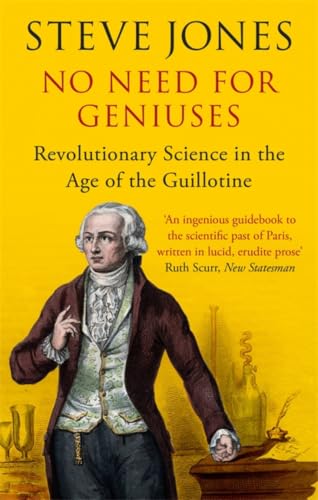
No need for geniuses : revolutionary science in the Age of the Guillotine / Steve Jones.
Material type: TextLanguage: English Publisher: London : Abacus, 2017Description: xxx, 353 pages : illustrations ; 20 cmContent type:
 - text
- unmediated
- volume
- 9781408705940 (paperback)
- 140870594X (paperback)
- Revolutionary science in the age of the Guillotine
- Q 127 J79n 2017
| Item type | Current library | Home library | Collection | Shelving location | Call number | Copy number | Status | Barcode | |
|---|---|---|---|---|---|---|---|---|---|
 Libro
Libro
|
Biblioteca Juan Bosch | Biblioteca Juan Bosch | Humanidades | Humanidades (4to. Piso) | Q 127 J79n 2017 (Browse shelf(Opens below)) | 1 | Available | 00000198811 |
Includes index.
Preface: Confessions of a Soixante-Huitard
Dramatis personae
Prelude: A flash of inspiration
The wall of the Farmers-general
Ashes to ashes
Let them eat chips
Fire and ice
Einstein's pendulum
The empire of anarchy
A degree of latitude
President Jefferson's Moose
Handing it on
Envoi: After the deluge
Paris at the time of the French Revolution was the world capital of science. Its scholars laid the foundations of today's physics, chemistry and biology. They were true revolutionaries: agents of an upheaval both of understanding and of politics. Many had an astonishing breadth of talents. The Minister of Finance just before the upheaval did research on crystals and the spread of animal disease. After it, Paris's first mayor was an astronomer, the general who fought off invaders was a mathematician while Marat, a major figure in the Terror, saw himself as a leading physicist. Paris in the century around 1789 saw the first lightning conductor, the first flight, the first estimate of the speed of light and the invention of the tin can and the stethoscope. The metre replaced the yard and the theory of evolution came into being. The city was saturated in science and many of its monuments still are. The Eiffel Tower, built to celebrate the Revolution's centennial, saw the world's first wind-tunnel and first radio message, and first observation of cosmic rays. Perhaps the greatest Revolutionary scientist of all, Antoine Lavoisier, founded modern chemistry and physiology, transformed French farming, and much improved gunpowder manufacture. His political activities brought him a fortune, but in the end led to his execution. The judge who sentenced him - and many other researchers - claimed that 'the Revolution has no need for geniuses'. In this enthralling and timely book Steve Jones shows how wrong this was and takes a sideways look at Paris, its history, and its science, to give a dazzling new insight into the City of Light -- Source other than Library of Congress.
There are no comments on this title.