
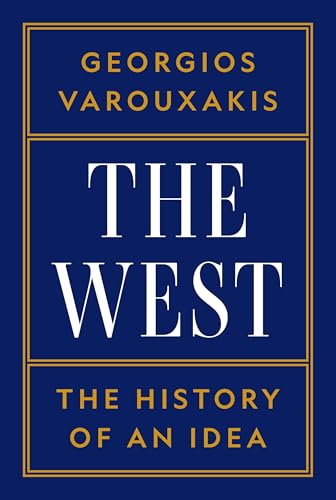
The west : the history of an idea / Georgios Varouxakis.
Material type: TextLanguage: English Publisher: Princeton : Princeton University Press, 2025Description: xviii, 491 pages : illustrations ; 25 cmContent type:
 - text
- unmediated
- volume
- 9780691177182 (hardback)
- 069117718X (hardback)
- CB 245 V324w 2025
| Item type | Current library | Home library | Collection | Shelving location | Call number | Copy number | Status | Barcode | |
|---|---|---|---|---|---|---|---|---|---|
 Libro
Libro
|
Biblioteca Juan Bosch | Biblioteca Juan Bosch | Recursos Regionales | Recursos Regionales (2do. Piso) | CB 245 V324w 2025 (Browse shelf(Opens below)) | 1 | Available | 00000199066 |
The Spengler Affair: The Decline of the West
Includes bibliographical references and index.
1. Introduction: 'The West' -- I. The West, 'from Plato to NATO'? -- II. A Russian Import, or a Substitute for 'Whiteness'? -- III. A Gradual Growth, Consummated in Paris, rue Monsieur-le-Prince -- IV. This Book -- 2. 'The West' as an Alternative to 'Europe' in the Nineteenth Century -- I. Heeren of Göttingen -- II. From North-South to East-West: Mme de Staël and the View of Russia -- III. Les Deux Mondes: Saint-Simon and the Saint-Simonians -- IV. Greeks Bearing Gifts? Or 'la garantie veritable de l'Occident contre l'Orient'
V. Fear of Russia Intensifies: 'the West' Must Unite... -- VI. The East of Xerxes or the East of Christ? -- VII. The Unlikely Godfather: Auguste Comte and the Substitution of Occident for Europe -- VIII. Comte's Political Project: The 'Republic of the West' -- IX. From L'Europe to L'Occident -- X. Positivist Contributions after Comte -- XI. Conclusion -- 3. Insular Britain Joins the West -- I. Insular Britain versus Continental Occident -- II. Early Uses of 'West' and 'Western' -- III. 'Europe' and 'the Liberties of Europe'
IV. Different 'Others': 'The West' versus 'Northern'/'Eastern' Russia, 'Oriental' Jews, and Turkey -- V. Edward Freeman and the 'Eternal' Struggle of 'the West' against 'the East' -- VI. The British Comtists' West -- VII. The Novelty of 'the West' in English -- VIII. The Wages of Foreign Influence -- IX. Conclusion -- 4. Ex Germaniae lux? How Did the Idea of 'the West' Reach America? -- I. Heidelberg, Göttingen, Halle, Berlin... -- II. From Franz Lieber to Francis Lieber -- III. The Need 'to have a distinct name for the indicated group': 'Western'? 'Occidental'? 'Cis-Caucasian'?
IV. 'Orientalism' and 'Occidentalism': America, 1853 -- V. European Immigrants and Eastern Questions -- VI. Occidentalism versus Orientalism (and Yet Another German-Educated American Academic) -- VII. 'The Meeting of the Orient and the Occident, Long Foreshadowed': Academic Political Science and 'Western Civilisation' -- VIII. Afro-American Radicalism versus Russian Menace? (And Japan as a Beacon of Hope) -- IX. Civilisations and Civilisationism: Alexander Crummell, William H. Ferris, W.E.B. Du Bois -- X. Conclusion -- 5. The War of Words: 'Western Civilisation' and 'the West', 1914-1919
I. 'We shall carry on this war to the end as a Kulturvolk': German Professors and 'the Civilised World' -- II. 'We are Europeans': America 'taken back into the fold' -- III. 'If not civilization, at least our civilization is at stake': The West according to 'the Zelig of twentieth-century politics' -- IV. Rabindranath Tagore on East and West -- V. Black America as the 'acid test for Occidental Civilization' -- VI. Thomas Mann's 'monstrous article' -- and His Reflections -- VII. Conclusion -- 6. From 'Decline of the West' to 'Defence of the West': The Interwar Years and the Crisis of Civilisation
A comprehensive intellectual history of the idea of the West How did "the West" come to be used as a collective self-designation signaling political and cultural commonality? When did "Westerners" begin to refer to themselves in this way? Was the idea handed down from the ancient Greeks, or coined by nineteenth-century imperialists? Neither, writes Georgios Varouxakis in The West, his ambitious and fascinating genealogy of the idea. "The West" was not used by Plato, Cicero, Locke, Mill, or other canonized figures of what we today call the Western tradition. It was not first wielded by empire-builders. It gradually emerged as of the 1820s and was then, Varouxakis shows, decisively promoted in the 1840s by the French philosopher Auguste Comte (whose political project, incidentally, was passionately anti-imperialist). The need for the use of the term "the West" emerged to avoid the confusing or unwanted consequences of the use of "Europe." The two overlapped, but were not identical, with the West used to differentiate from certain "others" within Europe as well as to include the Americas. After examining the origins, Varouxakis traces the many and often astonishingly surprising changes in the ways in which the West has been understood, and the different intentions and consequences related to a series of these contested definitions. While other theories of the West consider only particular aspects of the concept and its history (if only in order to take aim at its reputation), Varouxakis' analysis offers a comprehensive account that reaches to the present day, exploring the multiplicity of current, and not least, prospective future meanings. He concludes with an examination of how, since 2022, definitions and membership of the West have been reworked to consider Ukraine, as the evolution and redefinitions continue.
There are no comments on this title.