
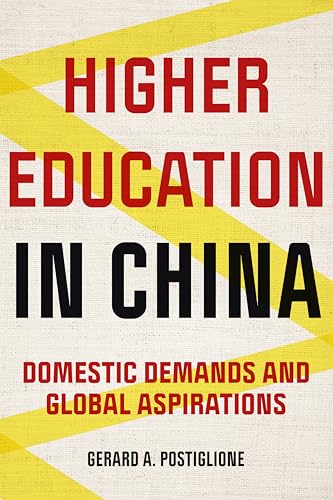
Higher education in China : domestic demands and global aspirations / Gerard A. Postiglione.
Material type: TextLanguage: English Publisher: Baltimore : Johns Hopkins University Press, 2026Description: xiv, 276 pages ; 23 cmContent type:
 - text
- unmediated
- volume
- 9781421454511 (paperback)
- 1421454513 (paperback)
- LA 1133 P857h 2026
| Item type | Current library | Home library | Collection | Shelving location | Call number | Copy number | Status | Barcode | |
|---|---|---|---|---|---|---|---|---|---|
 Libro
Libro
|
Biblioteca Juan Bosch | Biblioteca Juan Bosch | Humanidades | Humanidades (4to. Piso) | LA 1133 P857h 2026 (Browse shelf(Opens below)) | 1 | Available | 00000199082 |
Book collections on Project MUSE
Includes bibliographical references and index.
Contents -- Preface -- 1. Aspiring to Global Leadership -- 2. Legacy, Reform, and Global Engagement -- 3. Skills, Technology, and Employment -- 4. Equity, Exams, and Merit -- 5. Govern, Diversify, and Align -- 6. Hong Kong: Exceptionalism and Integration -- 7. Sustaining Sino-U.S. Academic Resilience -- 8. Leveraging Innovation for Global Engagement -- Notes -- Index.
"By 2020, China had nearly as many graduates with a higher education degree as there are people in the United States. What does a future with a quarter-billion highly educated Chinese will mean for China and the rest of the world? This book takes up this question, considering China's massive investment in higher education and the export of its scholars and scholarship. It also recognizes that China's global aspirations are constrained by domestic demands, political exigencies, and its own elitist academic culture"-- Provided by publisher.
"Assessing the trajectory of China's higher education system amid competing domestic priorities and global ambitions.By 2025, China had twice as many college students as the United States, four times as many STEM graduates, and double the number of STEM PhDs. What will it mean for the global future when a quarter of a billion Chinese citizens hold higher education degrees? In this timely book, Gerard A. Postiglione-an internationally recognized authority on Chinese education-offers a panoramic view of the world's largest state-directed higher education system and its complex interplay with China's social, economic, and geopolitical ambitions. At the center of Postiglione's analysis is the tension between domestic imperatives and global aspirations. As China aims to cultivate a world-significant higher education system by 2035, it faces a trio of formidable challenges: graduate employment, equitable access, and governance reform. Higher Education in China unpacks how elite Chinese research institutions and rapidly expanding second- and third-tier colleges are navigating these pressures amid a shifting landscape shaped by urban-rural inequality, labor market demands, and technological disruption. Based on policy consultation with China's Ministry of Education and on-the-ground research in nearly every province, Postiglione's account brings unmatched depth and perspective. He traces how returnee scholars, massification policies, and regional development initiatives have transformed campuses and classrooms, while also posing difficult questions about sustainability, quality, and inclusion. Higher Education in China illustrates how the country's evolving academic system may influence its long-term trajectory-and, by extension, reshape the global order of knowledge and innovation"-- Provided by publisher.
There are no comments on this title.