
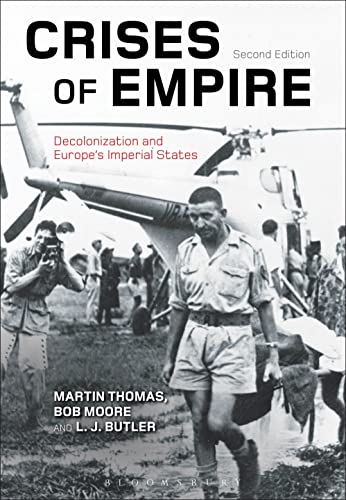
Crises of empire : decolonization and Europe's imperial states / Martin Thomas, Bob Moore, and L.J. Butler.
Material type: TextLanguage: English Publication details: London : Bloomsbury Academic Publishing, 2015Edition: Second editionDescription: xii, 455 pages : maps ; 24 cmISBN:
 - 9781472530257
- 147253025X
- JV 151 T459c 2015
| Item type | Current library | Home library | Collection | Shelving location | Call number | Copy number | Status | Barcode | |
|---|---|---|---|---|---|---|---|---|---|
 Libro
Libro
|
Biblioteca Juan Bosch | Biblioteca Juan Bosch | Ciencias Sociales | Ciencias Sociales (3er. Piso) | JV 151 T459c 2015 (Browse shelf(Opens below)) | 1 | Available | 00000198883 |
Includes bibliographical references and index.
Preface
Introduction: Constructions of decolonization
Part I: British Decolonization
Introduction to Part I
1. The British Empire, 1918-1945: Interwar Change and Wartime Pressures
2. The First Wave of British Decolonization:
Commonwealth Territories, South Asia and the Gold Coast, 1945-1951
3. British Decolonization, Insurgency and Strategic Reverse: The Middle East, Africa and Malaya, 1951-1957
4. Winds of Change: The Final Waves of British Decolonization in Africa and Asia after 1957
Part II: French Decolonization
Introduction to Part II
5. The Roots of French Decolonization: Ideas, Economics and Reform, 1900-1946
6. Decolonizing the French African Federations after 1945
7. People's War and the Collapse of French Indochina, 1945-1954
8. From French North Africa to Maghreb Independence: Decolonization in Morocco, Tunisia and Algeria, 1945-1956
9. Algeria's Violent Struggle for Independence
10. Territories Apart: Madagascar, the Togo Trusteeship and French Island Territories
Part III: Dutch Decolonization
Introduction to Part III
11. An 'Ethical Imperialism'? The Dutch Colonial Empire Before 1945
12. Indonesia: The Politics of Delusion, 1940-1947
13. Indonesia: The Realities of Diplomacy
14. Unfinished Business: New Guinea as a Last Outpost of Empire
15. Decolonization by Default: Dutch Disengagement in Suriname
Part IV: Contrasting Patterns of Decolonization
16. Contrasting Patterns of Decolonization: Belgian and Portuguese Africa
Conclusion: Changing Attitudes to the End of Empire
Glossary
Bibliography
Index
Crises of Empire offers a comprehensive and uniquely comparative analysis of the history of decolonization in the British, French and Dutch empires. By comparing the processes of decolonization across three of the major modern empires, from the aftermath of the First World War to the late 20th century, the authors are able to analyse decolonization as a long-term process. They explore significant changes to the international system, shifting popular attitudes to colonialism and the economics of empire. --Publisher description
This new edition incorporates the latest developments in the historiography, as well as:
- Increased coverage of the Belgian and Portuguese empires
- New introductions to each of the three main parts, offering some background and context to British, French and Dutch decolonization
- More coverage of cultural aspects of decolonization, exploring empire 'from below'
This new edition of Crises of Empire is essential reading for all students of imperial history and decolonization. In particular, it will be welcomed by those who are interested in taking a comparative approach, putting the history of decolonization into a pan-European framework.
There are no comments on this title.