
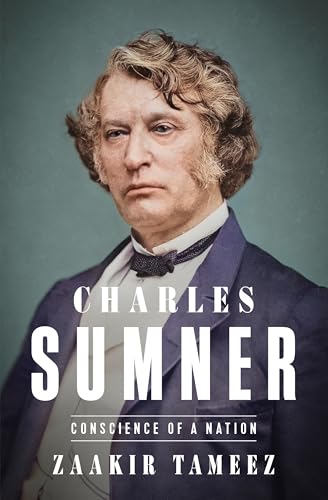
Charles Sumner : conscience of a nation / Zaakir Tameez.
Material type: TextLanguage: English Publisher: New York : Henry Holt and Company, 2025Edition: First editionDescription: x, 629 pages, 8 unnumbered pages of plates : illustrations, portraits ; 25 cmContent type:
 - text
- unmediated
- volume
- 9781250362551 (hardcover)
- 1250362555 (hardcover)
- Conscience of a nation
- Sumner, Charles, 1811-1874
- United States. Congress. Senate -- Biography
- Estados Unidos. Congreso. Senado -- Biografía
- Free Soil Party (U.S.)
- Partido de Suelo Libre (Estados Unidos)
- Legislators -- United States -- Biography
- Legisladores -- Estados Unidos -- Biografías
- Slavery -- Political aspects -- United States -- History -- 19th century
- Esclavitud -- Aspectos políticos -- Estados Unidos -- Historia
- Antislavery movements -- United States -- History -- 19th century
- Movimientos antiesclavistas -- Historia -- Estados Unidos -- Siglo XIX
- Reconstruction (U.S. history, 1865-1877)
- Reconstrucción (Estados Unidos, 1863-1877)
- United States -- Politics and government -- 1849-1877
- Estados Unidos -- Politica y gobierno -- 1849-1877
- Boston (Mass.) -- Biography
- Boston (Massachusetts)
- 973.7/114092
- 002 E 415.9 S956T 2025
| Item type | Current library | Home library | Collection | Shelving location | Call number | Copy number | Status | Barcode | |
|---|---|---|---|---|---|---|---|---|---|
 Libro
Libro
|
Biblioteca Juan Bosch | Biblioteca Juan Bosch | Recursos Regionales | Recursos Regionales (2do. Piso) | 002 E 415.9 S956T 2025 (Browse shelf(Opens below)) | 1 | Available | 00000202822 |
Includes bibliographical references and index.
Brahmin Outcast -- The Slave Power -- The War Power -- The Republican Guarantee -- Equality Before the Law.
"A landmark biography of Charles Sumner, the unsung hero of the American Civil War and Reconstruction Charles Sumner is mainly known as the statesman who barely survived a brutal caning on the Senate floor by the slaveholder Preston Brooks in 1856. This violent episode has obscured Sumner's epic life as one of America's most visionary constitutional thinkers, a man who advocated for multiracial democracy and championed equal rights more than one hundred years before the civil rights movement. A friend of Alexis de Tocqueville, an ally of Frederick Douglass, and an adviser to Abraham Lincoln, Sumner helped devise the Emancipation Proclamation, the Thirteenth Amendment, the Freedmen's Bureau, and the blueprint for what eventually became the Civil Rights Act of 1964. He valued principles above politics and was prepared to put his life on the line for the sake of racial justice. In Charles Sumner, Zaakir Tameez paints a vivid portrait of a civil rights crusader whose story has been overshadowed by the violent caning. With fresh research and lucid prose, Tameez chronicles Sumner's childhood upbringing--only decades after the American Revolution--in a poor white family that lived in a free Black neighborhood in Boston. He argues that Sumner was likely a gay man who struggled with love and heartbreak at a time when homosexuality wasn't well understood. And he depicts Sumner as a towering intellectual, one of the legal masterminds behind Reconstruction, and one of the founding fathers of the postwar Constitution premised on equality for all. An extraordinary achievement of historical and constitutional scholarship, Charles Sumner provides many valuable lessons for an increasingly partisan America divided, once again, over questions of race, democracy, and constitutional law"-- Provided by publisher.
There are no comments on this title.