
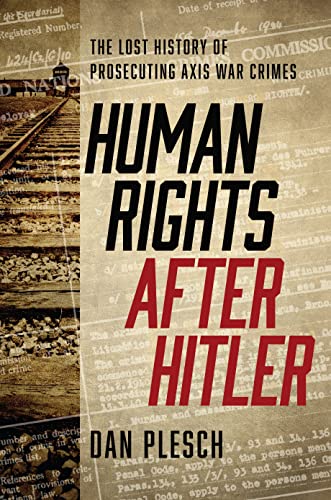
Human rights after Hitler : the lost history of prosecuting Axis war crimes / Dan Plesch.
Material type: TextLanguage: Spanish Publisher: Washington, DC : Georgetown University Press, [2017]Description: xx, 251 pages : illustrations ; 24 cmContent type:
 - text
- unmediated
- volume
- 9781626164314 (hbk : alk. paper)
- United Nations War Crimes Commission -- History
- Comisión de Crímenes de Guerra de las Naciones Unidas -- Historia
- War crime trials -- History -- 20th century
- Procesos por crímenes de guerra
- Crímenes de guerra -- Procesos -- Nuremberg, -- 1945-1946
- World War, 1939-1945 -- Atrocities
- Guerra Mundial II, 1939-1945 -- Atrocidades
- Holocaust, Jewish (1939-1945) -- Historiography
- Holocausto judío (1939-1945) -- Historiografía
- 341.6/9 23
- KZ 1174.5 P726h 2017
| Item type | Current library | Home library | Collection | Shelving location | Call number | Copy number | Status | Barcode | |
|---|---|---|---|---|---|---|---|---|---|
 Libro
Libro
|
Biblioteca Juan Bosch | Biblioteca Juan Bosch | Ciencias Sociales | Ciencias Sociales (3er. Piso) | KZ 1174.5 P726h 2017 (Browse shelf(Opens below)) | 1 | Available | 00000127479 |
Includes bibliographical references and index.
Prosecuting rape : the modern relevance of World War II legal practices -- A new paradigm for providing justice for international human rights violations -- When the allies condemned the Holocaust -- Pursuing war criminals all over the world -- The Holocaust indictments : prosecuting the "foot soldiers of atrocity" -- Fair trials and collective responsibility for criminal acts -- Crimes against humanity : the "freedom to lynch," and the indictments of Adolf Hitler -- Liberating the Nazis -- The legacy unleashed.
Human Rights after Hitler is a groundbreaking history about the forgotten work of the UN War Crimes Commission (UNWCC), which operated during and after World War II in response to Axis atrocities. He explains the commission's work, why its files were kept secret, and demonstrates how the lost precedents of the commission's indictments should introduce important new paradigms for prosecuting war crimes today. The UNWCC examined roughly 36,000 cases in Europe and Asia. Thousands of trials were carried out at the country-level, and hundreds of war criminals were convicted. This rewrites the history of human rights in the wake of World War II, which is too focused on the few trials at Nuremberg and Tokyo. Until a protracted lobbying effort by Plesch and colleagues, the UNWCC's files had been kept out of public view in the UN archives under pressure from the US government. The US initially wanted the files closed to smooth the way for post-war collaboration with Germany and Japan, and the few researchers who did gain permission to see the files were not permitted to even take notes until the files' recent release. Now revealed, the precedents set by these cases should have enormous practical utility for prosecuting war crimes today.
There are no comments on this title.